Mastering Playwright for Web Automation and Testing
Modern web applications are becoming more interactive, dynamic, and complex. As a result, developers and QA professionals need reliable tools to automate browser interactions, validate application workflows, and identify defects before they reach users.
Playwright is an open-source browser automation framework developed by Microsoft. It supports Chromium, Firefox, and WebKit and provides powerful capabilities for end-to-end testing, browser automation, API testing, debugging, and cross-browser validation.
Whether you are a web developer, QA engineer, automation tester, or someone transitioning into software testing, learning Playwright can help you build practical skills for modern web application testing.
What Is Playwright?
Playwright is a browser automation framework that allows developers and testers to control browsers programmatically.
It can automate activities such as:
-
Opening web pages
-
Clicking buttons and links
-
Filling forms
-
Uploading files
-
Selecting options
-
Handling browser dialogs
-
Validating page content
-
Taking screenshots
-
Recording test execution
-
Intercepting network requests
Playwright supports Chromium, Firefox, and WebKit browser engines, making it useful for cross-browser testing.
It can be used with JavaScript and TypeScript, as well as other officially supported language bindings such as Python, Java, and .NET.
Is Playwright an Extension?
The term “Playwright Extension” can be confusing.
Playwright itself is not simply a browser extension. It is a browser automation and testing framework that can be installed and used in development projects.
It also provides command-line tools and developer-focused utilities, such as Codegen and Trace Viewer, that support the testing workflow.
Therefore, for SEO and technical accuracy, it is generally better to use terms such as Playwright, Playwright testing, or Playwright automation rather than treating “Playwright Extension” as the official name of the framework.
Who Should Learn Playwright?
Playwright can be useful for professionals and learners working with web applications.
It is suitable for:
-
QA automation engineers
-
Software testers
-
SDETs
-
Web developers
-
JavaScript developers
-
TypeScript developers
-
Manual testers moving into automation
-
DevOps professionals working with CI/CD
Beginners can also learn Playwright if they first develop basic knowledge of programming, web technologies, and software testing.
Why Is Playwright Important?
Traditional manual testing can become time-consuming when an application has hundreds of user workflows that need to be checked repeatedly.
Playwright helps automate these workflows so that they can be executed consistently.
For example, an e-commerce application may require testing of:
Login → Search → Product Selection → Add to Cart → Checkout → Payment → Order Confirmation
Instead of manually repeating this workflow after every major application update, automation can perform the required checks repeatedly.
This can help development teams receive faster feedback during development and regression testing.
Key Features of Playwright
Playwright provides a broad set of capabilities for modern web testing and automation.
| Feature | Description |
|---|---|
| Cross-browser testing | Test applications across Chromium, Firefox, and WebKit |
| Browser automation | Automate real browser interactions |
| Auto-waiting | Helps synchronize actions with page state |
| Locators | Provides APIs for finding and interacting with elements |
| Screenshots | Capture application states during testing |
| Video recording | Record test execution when configured |
| Trace Viewer | Investigate test execution and failures |
| Network interception | Monitor or modify network requests |
| API testing | Send HTTP requests and validate responses |
| Parallel testing | Execute suitable tests concurrently |
| CI/CD integration | Run automated tests in development pipelines |
Cross-Browser Testing with Playwright
One of Playwright’s major advantages is its support for multiple browser engines.
The primary browser engines supported by Playwright are:
-
Chromium
-
Firefox
-
WebKit
This makes it possible to test whether important application workflows behave consistently across different browser environments.
For example, a team may configure its test suite to run against Chromium for general testing and Firefox and WebKit for additional browser coverage.
Automated Browser Interactions
Playwright can simulate many actions performed by real users.
For example:
import { test, expect } from '@playwright/test';

test('login test', async ({ page }) => {
  await page.goto('https://example.com/login');

  await page.getByLabel('Email').fill('user@example.com');
  await page.getByLabel('Password').fill('password');

  await page.getByRole('button', { name: 'Login' }).click();

  await expect(page).toHaveURL(/dashboard/);
});
This test opens a login page, fills the required fields, submits the form, and verifies the resulting URL.
Playwright Locators
Reliable element selection is essential for stable automation tests.
Playwright provides locator APIs such as:
page.getByRole('button', { name: 'Submit' })
page.getByLabel('Email')
page.getByText('Welcome')
Using meaningful locators can make automation scripts easier to understand and maintain.
Auto-Waiting in Playwright
Modern websites often load elements asynchronously. An automation script may therefore need to wait until an element is ready for interaction.
Playwright’s locator and action APIs include automatic waiting behavior for many common conditions.
This can reduce the need for arbitrary delays such as:
await page.waitForTimeout(5000);
Instead, testers should generally use locators and assertions that synchronize with the application’s expected state.
Network Interception
Playwright allows automation engineers to monitor, modify, or mock network traffic.
For example:
await page.route('**/api/products', async route => {
  await route.fulfill({
    status: 200,
    contentType: 'application/json',
    body: JSON.stringify({
      products: []
    })
  });
});
This can be useful when testing applications that depend on APIs or external services.
Network interception can help testers create controlled scenarios and verify how an application behaves when specific responses are returned.
API Testing with Playwright
Playwright is not limited to browser-based testing.
Its request capabilities can also be used to test APIs.
For example:
import { test, expect } from '@playwright/test';

test('API response test', async ({ request }) => {
  const response = await request.get('/api/users');

  expect(response.ok()).toBeTruthy();
});
API testing can complement end-to-end browser testing by validating backend functionality independently.
Screenshots and Videos
Playwright can capture screenshots and, when configured, record videos of test execution.
For example:
await page.screenshot({
  path: 'homepage.png',
  fullPage: true
});
These artifacts can help testers understand the state of an application when a test succeeds or fails.
Playwright Trace Viewer
Debugging automated tests can sometimes be difficult, especially when a failure occurs only in a CI environment.
Playwright’s Trace Viewer provides detailed information about test execution.
Depending on the configuration, a trace can help developers inspect:
-
Actions performed
-
Screenshots
-
Network activity
-
Page state
-
Timing information
-
Test failures
This makes traces useful when diagnosing complex automation problems.
Getting Started with Playwright
A basic Playwright setup can be completed in a few steps.
Step 1: Install Node.js
For JavaScript or TypeScript projects, install a supported version of Node.js.
Step 2: Create a Playwright Project
A new Playwright Test project can be created using:
npm init playwright@latest
The setup wizard helps configure the project and test environment.
Step 3: Create Your First Test
Create a test file and use Playwright’s testing APIs to automate a simple workflow.
Step 4: Run the Test
Use:
npx playwright test
This runs the configured Playwright test suite.
Step 5: Run Tests in Headed Mode
For debugging, you can run:
npx playwright test --headed
This allows you to observe the browser while the test executes.
Step 6: Use Debug Mode
Playwright also provides a debugging mode:
npx playwright test --debug
This can be useful when developing and troubleshooting tests.
Using Playwright Codegen
Playwright Codegen can help beginners understand browser automation syntax.
For example:
npx playwright codegen https://example.com
Codegen records browser interactions and generates Playwright code.
It is useful for learning and creating an initial automation script, but generated code should be reviewed and optimized before being used in a production automation framework.
Real-World Use Cases of Playwright
Playwright can be applied to several types of testing and automation.
End-to-End Testing
End-to-end testing validates complete user workflows.
Examples include:
-
User registration
-
Login
-
Shopping cart workflows
-
Checkout
-
Account management
-
Search functionality
-
Form submission
-
Employee portals
-
Customer dashboards
Regression Testing
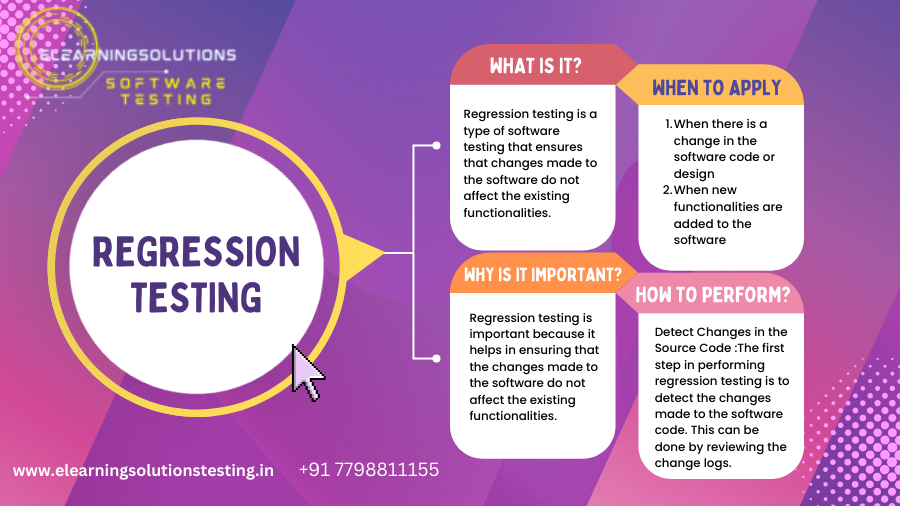
Regression testing verifies that existing functionality continues to work after application changes.
Playwright can automate repeatable regression scenarios and integrate them into CI/CD workflows.
Cross-Browser Testing
Organizations can use Playwright to validate important workflows across Chromium, Firefox, and WebKit.
This helps teams identify browser-specific issues before software reaches production.
API Testing
Playwright’s request capabilities can be used alongside browser testing to validate APIs and backend responses.
Visual Validation
Screenshots can be used as part of visual testing workflows to identify unexpected UI changes.
Visual comparison requires an appropriate baseline and configuration, so screenshots alone should not be considered a complete visual regression solution.
Playwright vs Selenium
Playwright and Selenium are both popular browser automation technologies.
| Feature | Playwright | Selenium |
|---|---|---|
| Browser automation | Yes | Yes |
| Chromium | Yes | Yes |
| Firefox | Yes | Yes |
| WebKit | Yes | Selenium has a different browser support model |
| Auto-waiting | Built into many APIs | Synchronization is handled differently |
| Languages | JavaScript/TypeScript, Python, Java, .NET | Multiple languages |
| Parallel execution | Supported by Playwright Test | Supported through Selenium ecosystem/tools |
| CI/CD | Yes | Yes |
| Ecosystem | Modern browser testing ecosystem | Large and mature ecosystem |
The choice between Playwright and Selenium depends on the project’s programming language, existing framework, infrastructure, browser requirements, and team experience.
Playwright vs Cypress
Cypress and Playwright are both popular tools for web application testing.
Cypress provides an integrated testing experience with strong developer tooling, while Playwright offers browser automation across Chromium, Firefox, and WebKit and supports broader browser interaction scenarios.
The right tool depends on the application, test requirements, team skills, and existing technology stack.
Skills Required to Learn Playwright
To become proficient in Playwright, develop a foundation in:
-
JavaScript or TypeScript
-
Node.js
-
HTML
-
CSS
-
DOM concepts
-
HTTP and APIs
-
Software testing fundamentals
-
Git
-
CI/CD concepts
Knowledge of frameworks such as React, Angular, or Vue can also be helpful when testing modern frontend applications.
Best Practices for Playwright Testing
Following good automation practices can make your test suite more stable and maintainable.
Use meaningful locators
Prefer accessible and stable locators instead of relying heavily on fragile CSS or XPath selectors.
Keep tests independent
Avoid unnecessary dependencies between tests.
Avoid arbitrary waits
Use Playwright’s built-in waiting behavior and meaningful assertions rather than relying on fixed delays.
Use reusable fixtures
Fixtures can help manage common setup and test dependencies.
Keep tests focused
A test should validate a clear business scenario rather than attempting to cover an entire application in one script.
Use debugging artifacts
Screenshots, videos, reports, and traces can make failed tests easier to investigate.
Run tests in CI
Integrating automated tests into CI/CD can provide faster feedback when application code changes.
Career Opportunities with Playwright
Playwright can be a valuable addition to the skill set of professionals working in software quality and automation.
Possible roles include:
-
QA Automation Engineer
-
Test Automation Engineer
-
SDET
-
Software Test Engineer
-
QA Engineer
-
Automation Developer
-
Software Developer in Test
Playwright alone does not guarantee a particular job or salary. Career opportunities depend on experience, programming skills, testing knowledge, location, and the overall technology stack.
Is Playwright Worth Learning?
Playwright is worth learning if you are interested in modern web automation and end-to-end testing.
It is especially useful for professionals who want to:
-
Automate modern web applications
-
Build browser testing frameworks
-
Perform cross-browser testing
-
Test complete user journeys
-
Integrate automation with CI/CD
-
Work with JavaScript or TypeScript testing tools
-
Develop practical QA automation skills
The strongest approach is to learn Playwright as part of a broader software testing and automation skill set.
How to Learn Playwright Effectively
A practical learning roadmap can look like this:
Step 1: Learn JavaScript or TypeScript fundamentals.
Step 2: Understand HTML, CSS, DOM, and browser concepts.
Step 3: Learn basic software testing concepts.
Step 4: Install Playwright and create a test project.
Step 5: Practice locators, actions, navigation, and assertions.
Step 6: Learn fixtures and test organization.
Step 7: Practice API testing and network interception.
Step 8: Learn screenshots, reports, and Trace Viewer.
Step 9: Practice cross-browser testing.
Step 10: Integrate your tests with Git and a CI/CD pipeline.
Building a real project while following these steps can help turn theoretical knowledge into practical automation skills.
Frequently Asked Questions
What is Playwright used for?
Playwright is used for browser automation, end-to-end testing, cross-browser testing, API testing, UI validation, and other automated web application workflows.
Is Playwright a browser extension?
No. Playwright is primarily a browser automation and testing framework. It includes command-line tools and developer utilities that support automated testing workflows.
Which browsers does Playwright support?
Playwright supports Chromium, Firefox, and WebKit browser engines.
Which programming languages can be used with Playwright?
Playwright provides official language support for JavaScript/TypeScript, Python, Java, and .NET.
Can Playwright be used for mobile testing?
Playwright supports mobile browser emulation through device profiles. This allows teams to simulate certain mobile browser conditions, but it is not a replacement for testing on every physical mobile device.
Is Playwright free?
Playwright is open-source and can be used for personal and commercial software projects under its applicable license.
Can Playwright replace Selenium?
Playwright can be an alternative to Selenium for many browser automation projects, but neither tool is universally better. The choice depends on project requirements, ecosystem, language, infrastructure, and team experience.
Can Playwright perform API testing?
Yes. Playwright provides request APIs that can be used for HTTP API testing alongside browser-based automation.
How long does it take to learn Playwright?
The learning time depends on your programming and testing experience. Beginners can learn the fundamentals relatively quickly, while developing production-quality automation frameworks requires continued practice.
Is Playwright useful for QA automation careers?
Yes. Playwright can strengthen a QA automation profile, particularly when combined with programming, API testing, Git, CI/CD, test framework design, and software testing fundamentals.
Conclusion
Playwright has become an important technology for modern web automation and end-to-end testing. Its support for Chromium, Firefox, and WebKit, combined with features such as locators, auto-waiting, network interception, API testing, screenshots, tracing, parallel execution, and CI/CD integration, makes it a powerful option for automated web testing.
For developers and QA professionals, learning Playwright alongside JavaScript or TypeScript, software testing fundamentals, API testing, Git, and CI/CD can provide a strong foundation for modern automation projects.
The best way to master Playwright is through hands-on practice. Start with simple browser interactions, gradually explore advanced features, and build a complete automation project that reflects real-world testing scenarios.