Introduction to Cypress Test Automation
In today’s fast-moving software industry, delivering high-quality applications quickly is a major priority for development and QA teams. As applications become more complex and release cycles become shorter, relying entirely on manual testing can make it difficult to maintain speed, consistency, and adequate test coverage.
This is where Cypress test automation becomes valuable.
Cypress is an open-source testing framework designed primarily for modern web applications. It provides tools for end-to-end and component testing and offers an interactive development experience that makes it easier to write, execute, and debug automated tests.
With features such as automatic waiting, network interception, interactive debugging, screenshots, and CI/CD support, Cypress has become an important technology for developers and software testing professionals.
Whether you are a beginner learning automation testing or an experienced QA engineer expanding your skills, understanding Cypress can help you build a stronger foundation in modern web test automation.
What Is Cypress Test Automation?
Cypress test automation involves using the Cypress framework to automatically verify the functionality and behavior of web applications.
Instead of manually performing the same actions repeatedly, testers can create automated tests that simulate user workflows.
For example, a Cypress test can:
- Open a web application.
- Navigate to a login page.
- Enter username and password.
- Click the login button.
- Verify that the dashboard appears.
- Report whether the test passed or failed.
A simple Cypress test looks like this:
describe('Login functionality', () => {
  it('should allow a valid user to log in', () => {
    cy.visit('/login')

    cy.get('[data-cy="username"]').type('testuser')
    cy.get('[data-cy="password"]').type('password123')
    cy.get('[data-cy="login-button"]').click()

    cy.url().should('include', '/dashboard')
  })
})
This approach can reduce repetitive manual effort and provide faster feedback during software development.
Who Should Learn Cypress Test Automation?
Cypress can be useful for a wide range of technology professionals.
Beginners in Software Testing
Cypress provides a practical way to start learning browser automation and understand concepts such as selectors, assertions, test cases, and automated user interactions.
Manual Testers
Manual testers who want to transition toward automation testing can add Cypress to their technical skill set.
JavaScript Developers
Cypress works with JavaScript and TypeScript, making it particularly relevant for frontend and full-stack developers.
QA Automation Engineers
Experienced automation professionals can use Cypress to develop maintainable test suites for modern web applications.
SDET Professionals
Software Development Engineers in Test can use Cypress alongside programming, API testing, Git, and CI/CD tools to build complete automation solutions.
Why Is Cypress Test Automation Important?
Modern software teams need to test applications continuously as new code is developed and deployed.
Cypress can help teams achieve:
- Faster testing feedback
- Reduced repetitive manual work
- Better regression coverage
- Easier test debugging
- More consistent test execution
- Integration with CI/CD pipelines
- Automated validation of important user workflows
However, automation does not eliminate the need for manual or exploratory testing. Instead, it complements manual testing by allowing repetitive and predictable scenarios to be automated.
Faster Feedback During Development
One of the major advantages of Cypress is its interactive testing experience.
Developers and testers can run tests while developing application functionality and quickly identify failures.
This shorter feedback loop can help teams discover defects earlier in the development lifecycle.
Real-Time Debugging
Cypress provides an interactive Test Runner that allows users to inspect commands and understand what happened during test execution.
When a test fails, testers can investigate the failing command, application state, browser behavior, and other available debugging information.
Automatic Waiting
Timing and synchronization problems are common in UI automation.
Cypress automatically retries many commands and assertions until their conditions are satisfied or a timeout is reached.
This reduces the need for unnecessary fixed delays in test scripts.
Key Features of Cypress Test Automation
| Feature | Benefit |
|---|---|
| Interactive Test Runner | Makes test execution and debugging easier |
| Automatic Waiting | Reduces many timing-related failures |
| Network Interception | Allows requests and responses to be monitored or controlled |
| Screenshots | Helps investigate failures |
| Video Recording | Useful for reviewing CI test execution |
| Fixtures | Helps manage reusable test data |
| Spies and Stubs | Allows controlled testing of application behavior |
| Component Testing | Tests supported UI components in isolation |
| CI/CD Integration | Allows tests to run automatically during development and deployment |
Getting Started With Cypress
Prerequisites
Before learning Cypress, it is helpful to have basic knowledge of:
- JavaScript or TypeScript
- HTML
- CSS
- DOM concepts
- Web browsers
- HTTP and APIs
- Software testing fundamentals
- Node.js and npm
- Git
You do not need to be an advanced programmer to begin, but stronger JavaScript knowledge will make advanced Cypress automation easier to learn.
Installing Cypress
Cypress can be installed as a development dependency in a Node.js project.
npm install cypress --save-devAfter installation, you can launch the Cypress application with:
npx cypress openFor command-line execution, you can use:
npx cypress runThis provides a convenient way to execute automated tests in CI environments.
Writing Your First Cypress Test
After setting up Cypress, you can create a test that validates a specific application behavior.
For example:
describe('Homepage', () => {
  it('should display the homepage correctly', () => {
    cy.visit('/')
    cy.get('h1').should('be.visible')
  })
})
This test:
- Opens the application
- Finds the heading
- Verifies that the heading is visible
As your knowledge grows, you can create more complex workflows involving forms, authentication, APIs, dynamic content, and application state.
Important Cypress Commands
Understanding Cypress commands is essential for writing effective automated tests.
cy.visit()
Used to navigate to a web page.
cy.visit('/login')cy.get()
Used to locate an element.
cy.get('[data-cy="email"]').type()
Used to enter text.
cy.get('[data-cy="email"]').type('test@example.com').click()
Used to interact with clickable elements.
cy.get('[data-cy="submit"]').click().should()
Used to perform assertions.
cy.get('.success-message').should('be.visible')Learning these commands gives beginners a strong foundation for Cypress automation.
Advanced Cypress Test Automation Features
Cypress Time-Travel Debugging
Cypress provides an interactive command log that allows testers to inspect different stages of test execution.
Rather than literally rewinding and modifying a running test, the Test Runner allows users to inspect snapshots and understand the state of the application at different commands.
This makes debugging significantly more visual.
Network Request Interception
Cypress provides cy.intercept() for monitoring and controlling network requests.
For example:
cy.intercept('GET', '/api/products', {
  fixture: 'products.json'
}).as('getProducts')
You can then wait for the request:
cy.wait('@getProducts')Network interception is particularly useful when testing applications that depend heavily on APIs.
Fixtures
Fixtures allow testers to store reusable test data separately from their test scripts.
For example, a JSON fixture could contain customer or product information that is reused across multiple tests.
This can make test suites easier to organize and maintain.
Custom Commands
When the same testing operation is repeated frequently, custom Cypress commands can help reduce duplication.
For example, teams may create reusable login functionality rather than repeating the same login steps in every test.
Cypress for Regression Testing
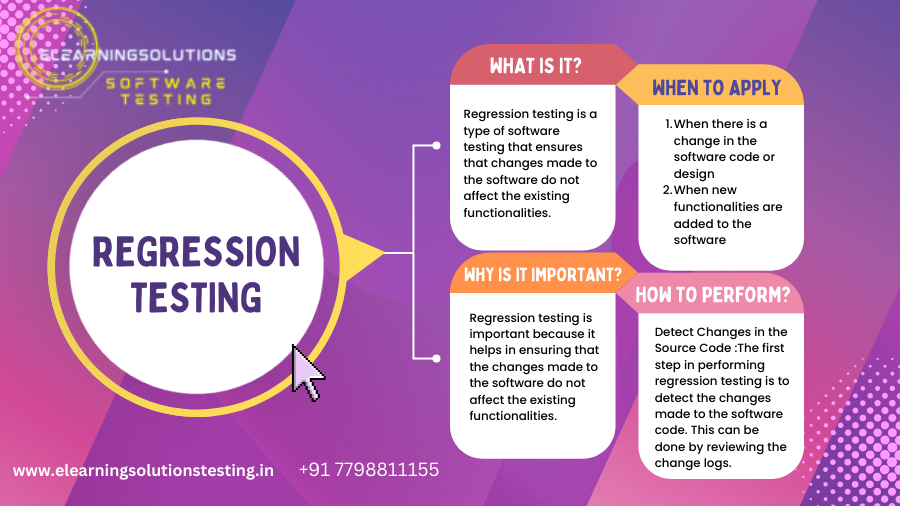
Regression testing verifies that existing functionality continues to work after changes are made to an application.
Cypress is well suited for automating repeatable regression scenarios such as:
- User login
- Registration
- Search
- Shopping cart
- Checkout
- Form validation
- Navigation
- User profile management
These tests can then be executed whenever new application changes are introduced.
Cypress for Cross-Browser Testing
Cypress supports testing in multiple modern browsers, including supported Chromium-based browsers and Firefox.
However, browser availability and feature support can vary by Cypress version and configuration.
Organizations should therefore define a browser strategy based on the browsers their users actually rely on.
External cloud testing platforms can also be used when teams require broader browser and operating-system coverage.
Cypress and Mobile Testing
Cypress is primarily designed for web application testing.
It can be useful for testing responsive web applications and mobile browser experiences, but it is not a native mobile application testing framework.
For native Android or iOS applications, specialized mobile testing tools are generally more appropriate.
This distinction is important for testers choosing an automation framework.
Cypress vs Selenium


Cypress and Selenium are both widely used for web automation, but they have different architectures and approaches.
| Area | Cypress | Selenium |
|---|---|---|
| Primary focus | Modern web testing | Browser automation |
| Programming | JavaScript/TypeScript | Multiple programming languages |
| Debugging | Interactive Test Runner | Depends on framework and tooling |
| Automatic waiting | Built into Cypress’s command model | Requires appropriate synchronization strategies |
| Ecosystem | Strong modern frontend testing ecosystem | Very mature and broad ecosystem |
| Browser automation architecture | Cypress-specific architecture | WebDriver-based |
| Best suited for | Modern web testing workflows | Broad browser automation requirements |
Neither tool is universally better. The appropriate choice depends on application requirements, team expertise, browser coverage, existing infrastructure, and testing strategy.
Cypress vs Playwright
Playwright is another modern browser automation framework that has become popular among developers and testers.
Cypress emphasizes an integrated developer experience and interactive debugging, while Playwright offers powerful browser automation capabilities and supports scenarios such as multiple browser contexts and multi-page workflows.
Teams should evaluate both tools based on their application architecture and testing requirements rather than choosing a framework solely because it is popular.
Cypress Best Practices
1. Use Stable Selectors
Avoid selectors that depend heavily on changing CSS classes.
Where appropriate, use dedicated test attributes:
<button data-cy="login-button">Login</button>Then:
cy.get('[data-cy="login-button"]').click()2. Avoid Unnecessary Hard Waits
Avoid relying on fixed delays such as:
cy.wait(5000)Instead, use assertions, network aliases, or application conditions that provide meaningful synchronization.
3. Keep Tests Independent
Tests should ideally be independent from one another.
If one test fails, other tests should still be able to execute wherever practical.
4. Create Small and Focused Tests
A test should validate a clear behavior rather than attempting to test an entire application in one large script.
5. Use Meaningful Test Names
Instead of:
loginTest1prefer:
should display an error for invalid login credentialsClear naming makes test suites easier to understand.
6. Avoid Over-Automation
Not every test needs to be automated.
Exploratory testing, usability testing, visual assessment, and certain one-time scenarios may still benefit from human involvement.
Cypress in CI/CD
One of the biggest benefits of test automation is the ability to integrate testing into CI/CD pipelines.
A typical workflow might look like:
Developer Commit → Build → Cypress Tests → Test Results → Deployment
Cypress tests can be executed automatically after code changes, helping teams identify defects before software reaches production.
This makes Cypress particularly useful in modern DevOps and continuous testing environments.
Skills Needed for a Cypress Automation Career
Learning Cypress alone is not enough to become a highly effective automation professional.
A strong skill set includes:
Technical Skills
- Manual testing
- JavaScript or TypeScript
- Cypress
- API testing
- SQL
- Git
- CI/CD
- HTML and CSS
- Web fundamentals
- Test case design
- Debugging
Soft Skills
Technical expertise should be supported by:
- Problem-solving
- Analytical thinking
- Communication
- Attention to detail
- Team collaboration
- Requirement understanding
- Curiosity and continuous learning
The strongest automation professionals understand both software quality principles and programming.
Career Opportunities in Cypress Test Automation
Cypress can complement several software testing career paths.
Potential roles include:
- QA Engineer
- Automation Test Engineer
- Software Test Engineer
- SDET
- QA Automation Engineer
- Quality Engineer
- Test Automation Lead
- Automation Architect
Cypress should be considered one component of a broader automation skill set rather than a standalone career qualification.
Does Cypress Certification Matter?
Cypress skills can be demonstrated through practical projects, professional experience, and knowledge of modern testing practices.
Before investing in a certification, check whether the credential is officially recognized and currently offered by the organization providing it.
For employers, practical automation ability is often more meaningful than simply listing a tool on a resume.
A strong portfolio could include:
- E2E test projects
- API testing examples
- CI/CD integration
- Git repositories
- Test reports
- Real-world application scenarios
Frequently Asked Questions About Cypress Test Automation
Is Cypress suitable for beginners?
Yes. Cypress has a relatively approachable developer experience. Beginners should ideally learn basic JavaScript, web concepts, and software testing fundamentals first.
Is Cypress a replacement for Selenium?
No. Cypress and Selenium solve overlapping problems but use different architectures and have different strengths. The right choice depends on project requirements.
Can Cypress perform cross-browser testing?
Yes. Cypress supports testing in multiple supported browsers. Teams should verify browser support and capabilities for their specific Cypress version and project requirements.
Can Cypress test mobile applications?
Cypress is primarily intended for web applications. It can be used for responsive and mobile-browser testing, but it is not a native Android/iOS automation framework.
Can Cypress be used for API testing?
Yes. Cypress provides commands and capabilities for working with HTTP requests and API-driven workflows.
Does Cypress support parallel testing?
Cypress supports parallelization through its cloud-based testing capabilities and CI workflows when configured appropriately. The exact setup depends on the Cypress features and infrastructure being used.
Is JavaScript required for Cypress?
JavaScript or TypeScript knowledge is strongly recommended because Cypress tests are commonly written using these languages.
What should I learn before Cypress?
A good learning sequence is:
Manual Testing → JavaScript → Web Fundamentals → Cypress → API Testing → Git → CI/CD → Advanced Automation
Conclusion
Cypress test automation is an important skill for professionals working with modern web applications. Its interactive testing experience, automatic waiting, network interception, debugging capabilities, browser support, and CI/CD integration make it a useful framework for automated web testing.
For beginners, Cypress provides a practical introduction to browser automation. For experienced QA professionals, it can become part of a broader automation strategy involving APIs, CI/CD, programming, and continuous testing.
However, successful automation engineers should not focus on Cypress alone. Combining Cypress with JavaScript or TypeScript, API testing, Git, CI/CD, SQL, and strong software testing fundamentals can create a much more valuable professional skill set.
As organizations continue to adopt faster development and deployment practices, professionals who understand modern test automation can play an important role in maintaining software quality.