
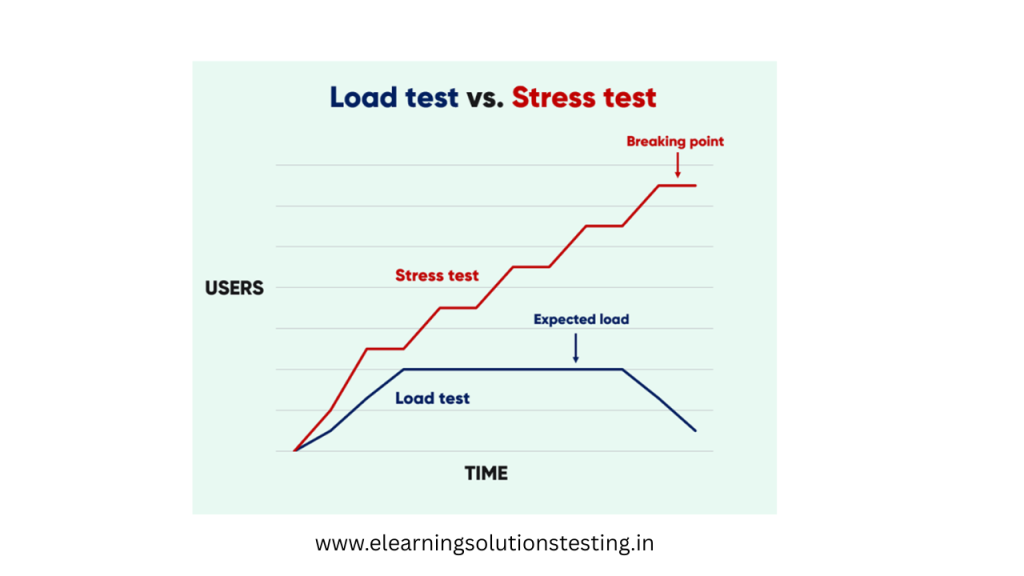
In the realm of software quality assurance, ensuring an application performs reliably under various user conditions is essential. Two core performance testing methods — Load Testing and Stress Testing — are often used for this purpose. While both assess how software behaves under pressure, their goals, scope, and outcomes are quite different.
Load Testing and Performance Testing
Let’s explore what makes them unique, supported by real-world scenarios for better understanding.
What is Load Testing?
Load Testing measures how a system performs under expected user loads. The goal is to determine whether the software can handle a specific number of concurrent users or transactions without any performance degradation.
Objective:
To ensure the application performs well under normal and peak usage conditions.
When to Use:
- Before product release to test against business-defined user capacity.
- After code or infrastructure updates to validate performance.
Scenario:
Imagine a banking web app expected to handle 1,000 users during normal business hours. Load testing simulates these 1,000 concurrent users logging in, transferring money, and checking account balances to verify that the app runs smoothly and meets response time expectations.
What is Stress Testing?
Stress Testing pushes the software beyond its maximum operating capacity to see how it behaves under extreme load or resource exhaustion. It helps identify breaking points and system recovery capabilities.
Objective:
To understand the software’s limits and how it fails under high pressure.
When to Use:
- To determine the upper performance limits of an application.
- To evaluate system behavior during traffic spikes or hardware failures.
Scenario:
Consider an online ticketing platform during a major concert sale. Stress testing simulates 10,000 users hitting the site at once — far beyond its expected load. The goal is to see if the system crashes, how gracefully it handles the overload, and whether it recovers once the load drops.
Key Differences Between Load and Stress Testing
| Factor | Load Testing | Stress Testing |
|---|---|---|
| Goal | Assess system performance under expected load | Examine system behavior beyond normal limits |
| Test Scope | Normal to peak expected conditions | Extreme conditions and resource exhaustion |
| Failure Expectation | Failures are not expected | Failures are anticipated to test recovery |
| Focus | Stability and response time | Crash points and recovery mechanisms |
| Outcome | Confirms if system meets performance criteria | Identifies breaking points and bottlenecks |
Why Both Are Important
- Load Testing ensures the application is production-ready and handles real-world usage efficiently.
- Stress Testing prepares your application for unexpected surges and helps you build a recovery strategy.
Using both gives a well-rounded view of the system’s strength and resiliency.
Final Thoughts
Load testing and stress testing are not interchangeable they serve different purposes in the performance testing cycle. Load testing checks if your app is ready for business; stress testing tells you how your app will behave when business spikes or things go wrong.
YOU MAY BE INTERESTED IN
The Art of Software Testing: Beyond the Basics
Automation testing course in Pune
Automation testing in selenium
Mastering Software Testing: A Comprehensive Syllabus
Frequently Asked Questions
What is the main difference between load testing and stress testing?
Load testing measures the performance of a system under a normal or expected workload, while stress testing pushes the system to its limits to see when it fails. This difference in approach helps teams identify different types of issues. By understanding these differences, teams can design more effective testing strategies.
Can load testing and stress testing be used together in the same testing scenario?
Yes, load testing and stress testing can be used together to provide a comprehensive understanding of a system’s performance and reliability. By starting with load testing to establish a baseline, teams can then proceed with stress testing to identify the system’s breaking point. This combined approach helps ensure the system can handle both normal and extreme conditions.
What are some common scenarios where load testing is more appropriate than stress testing?
Load testing is more suitable for scenarios such as simulating a large number of users accessing a website or application during peak hours, or testing the performance of a system under a sustained workload. This type of testing helps identify performance bottlenecks and areas for optimization. It is essential for ensuring a smooth user experience under normal operating conditions.
How do I determine when to stop a stress test to avoid damaging the system or its components?
When conducting a stress test, it’s essential to establish clear criteria for stopping the test, such as when the system fails, becomes unresponsive, or exhibits significant performance degradation. The test should be stopped immediately if any of these conditions are met to prevent damage to the system or its components. This approach helps ensure the test is safe and effective.
Can load testing and stress testing be automated, and what are the benefits of automation in this context?
Yes, load testing and stress testing can be automated using specialized tools and software. Automation provides several benefits, including increased efficiency, reduced testing time, and the ability to run tests repeatedly with minimal manual intervention. This allows teams to focus on analyzing results and optimizing system performance rather than manually executing tests.


