General insurance is comparable to health care or health insurance. As you are aware, the insurer (insurance business) will provide the plans, and the policyholder (subscriber) will purchase the policy that best suits his needs. The policyholders will pay the insurer the premium amount, and the insurer will compensate the policyholders for legitimate claims they have filed.
The same is true for health insurance, albeit there are additional significant contributors besides the policyholder and the insurer, including the broker, TPA (Third Party Administrator), and providers.
We will now see each of the major contributors in detail:
#1) Insurer: An entity that creates a plan, sells the policy and reimburses policyholder or provider for the submitted valid claims.
#2) Policy Holder: A person or an entity, who buys the policy from the insurer or broker, pays a premium to the insurer and sometimes submits a claim.

#3) Provider: A person or an entity, which provides the healthcare service to the policyholder and their dependents, either receive payment for the service from the policyholder or the insurer by submitting a claim.
#4) TPA: A person or an entity that manages the claims of the policyholder or provider and receives payment for the management from the respective contributor.
#5) Broker: As you have guessed, he is an agent who sells the policy to the customers on behalf of the insurer and receives a commission in return from the Insurer.
For Example, We can understand the basic function of contributors from the below example.
Mr. Enosh paid a premium to a healthcare firm for a health insurance policy that he purchased from Mr. Ponnar that covers general medical consultations and eyesight issues.
After Mr. Enosh became ill and sought medical advice from Mr. Sabari to help him recover, Sabari gave Enosh a prescription, filed a claim with HealthCorp Company for the consultation, and was paid. HealthCorp Company pays Mr. Ponnar a commission in exchange for Mr. Enosh paying the premium.
In the above example, ‘General Physician Consultation’ and ‘Vision Problems’ are the benefits of the health plan, Mr. Enosh is the policyholder, Mr. Ponnar is the broker, HealthCorp Company is the insurer and Mr. Sabari is the provider.
To clearly understand the difference between policy and plan, think plan as a class and policy as an object ( an instance of the class). A policy can be categorized as individual policy and group policy based on the type of beneficiaries it covers.
Individual Policy: An individual will be the policyholder; both the individual and his/her dependents will enjoy the benefits of the health plan. Here the individual pays the premium.
Group Policy: An entity (Generally an employer) will be the policyholder, the members (Employees) of the entity and their dependents will enjoy the benefits of the health plan. Here the entity pays the premium.
For Example, An example to have a clear idea of group policy is as follows,
MotoCorp Company buys a policy from HealthCorp Company for its employees and their family. Their claims are managed by EasyClaim Company. Here MotoCorp Company is the policyholder, HealthCorp Company is the Insurer and EasyCliam Company is the TPA.
How To Test a Healthcare Application?
Before testing an application, we should be aware of the healthcare industry workflow. The previous topic just gives an introduction to managed health care.
An Insurer needs different applications to manage the following:
- Provider data
- Member data
- Premium billing/payment
- Broker data
- Claims entry/validation
- Broker commission calculation/payment
Generally, a Healthcare application will have the following list of systems:
- Member system: To maintain policyholder data, various plans with their list of benefits and generate premium bills for the policyholder based on their plans
- Provider system: To maintain provider data
- Broker system: To maintain broker data and calculate commissions
- Claims system: For claim entry and validation
- Finance system: To do the necessary payment to provider/member/broker
- Member portal: To display the policyholder information, make premium payments and raise a request for change information for policyholders
- Provider portal: To display provider information and raise a request for change information for providers
- Broker portal: to display broker information and raise a request for change information for brokers
This list may not be all-inclusive. To the best of my knowledge, however, this is the list. Furthermore, not every application will be utilized. These apps are sometimes standalone systems, and other times a small number of them are combined to create a new combination application.
For Example, the Provider system can be part of the Member system in some healthcare applications. By Healthcare application, I mean a set of systems maintained by an Insurer to facilitate their customers and partners.
Health Care Application Testing Workflow
The unique feature of the Health Care system is that these applications cannot be tested in any order we like. There is a certain workflow to be followed:
- There should be a mechanism for the member system to verify the assigned provider since a member or policyholder must be paired with a primary care physician or a provider network in order to be enrolled in a health plan. Either a data feed from the provider system should be sent to the member system on a regular basis, or the member system connects to the provider system. Therefore, before evaluating the member system, the provider system should be tested and operational.
- A claim should consist of provider ID and member ID in addition to other details. The claim system should validate both the member and provider to validate the claim, so both member and provider system should be tested and ready to use before testing the claims system.
- The finance system needs to have data from a member, provider, claim and broker system to write checks or make EFT payments to the respective person or entity.
- Provider and broker systems are stand-alone.
- Portals should be tested at last since it needs data from the other applications.
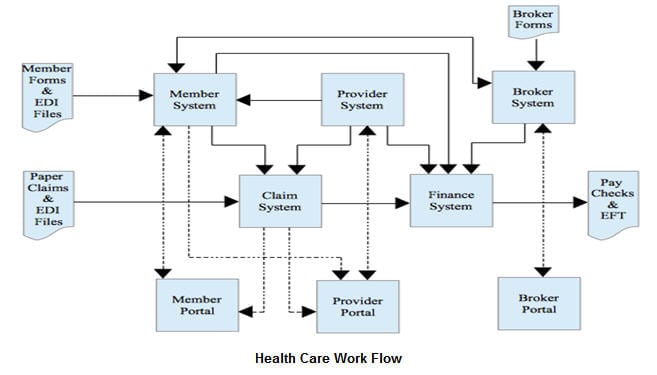
Now, that’s the order in which the systems in Healthcare application should be tested.
What’s Next?
The above-mentioned information should give us enough momentum to get into “How to test” the Healthcare applications, which will be dealt with in this article.
YOU MAY BE INTERESTED IN
The Art of Software Testing: Beyond the Basics
Automation testing course in Pune
Automation testing in selenium
Mastering Software Testing: A Comprehensive Syllabus
Frequently Asked Questions
What is the healthcare domain and its importance in the current era?
The healthcare domain refers to the application of information technology to improve the delivery of healthcare services, and its importance lies in its ability to enhance patient care, reduce costs, and improve health outcomes. This domain has become crucial in the current era due to the increasing demand for quality healthcare services. It involves the use of various technologies, including electronic health records, telemedicine, and healthcare analytics.
What are the key components of the healthcare domain?
The key components of the healthcare domain include healthcare providers, payers, patients, and healthcare IT systems. These components work together to deliver high-quality patient care, manage healthcare costs, and improve health outcomes. The healthcare domain also involves various stakeholders, including healthcare professionals, policymakers, and technology vendors.
What are the benefits of introducing technology in the healthcare domain?
The benefits of introducing technology in the healthcare domain include improved patient care, increased efficiency, and reduced costs. Technology can also help to enhance patient engagement, improve health outcomes, and support the development of personalized medicine. Additionally, technology can help to reduce medical errors, improve the accuracy of diagnoses, and enhance the overall quality of healthcare services.
How does the healthcare domain impact the quality of patient care?
The healthcare domain has a significant impact on the quality of patient care, as it enables healthcare providers to deliver high-quality, patient-centered care. The use of technology, such as electronic health records and telemedicine, can help to improve the accuracy of diagnoses, reduce medical errors, and enhance patient outcomes. The healthcare domain also involves the use of data analytics and other technologies to support the development of personalized medicine and targeted treatments.
What are the future trends and opportunities in the healthcare domain?
The future trends and opportunities in the healthcare domain include the use of artificial intelligence, blockchain, and the Internet of Things (IoT) to improve patient care and health outcomes. The healthcare domain is also expected to involve the increased use of telemedicine, virtual reality, and other digital technologies to enhance patient engagement and support the development of personalized medicine. Additionally, the use of data analytics and other technologies is expected to play a key role in the development of targeted treatments and precision medicine.