
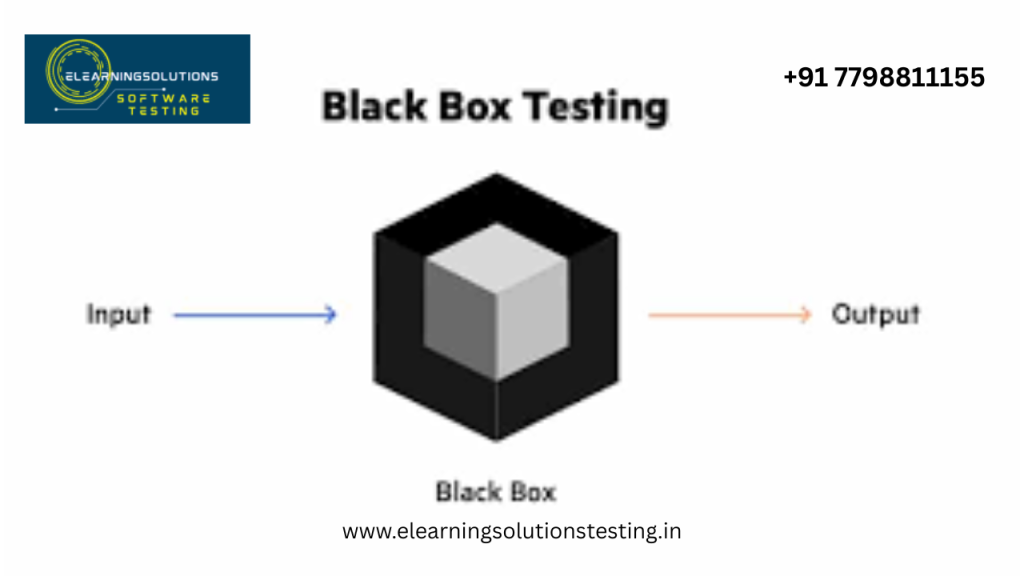
Imagine trying to understand how a machine works by only pressing its buttons and observing the results, without ever opening it. That is the core concept of Black Box Testing in software development.
This type of testing doesn’t require knowledge of the internal code. Instead, it focuses on what the software should do based on requirements. Let’s explore this essential testing method, its types, techniques, and real-world examples.
What is Black Box Testing?
Black Box Testing is a software testing method where testers evaluate the functionality of an application without knowing the internal code structure or logic. The tester interacts with the software by providing inputs and observing the outputs to ensure it behaves as expected.
It is often used during different phases of testing such as system testing, integration testing, and acceptance testing.
Key Features of Black Box Testing
- Focuses on software behavior, not internal structure
- Tests are derived from requirements and specifications
- Applicable for functional and non-functional testing
- Helps simulate real user interactions
Types of Black Box Testing
- Functional Testing
Verifies that the application performs its intended functions correctly. - Non-Functional Testing
Checks performance, scalability, usability, and reliability. - Regression Testing
Ensures that new code changes don’t break existing functionalities. - System Testing
Validates the complete and integrated application against requirements. - Acceptance Testing
Confirms the system is ready for use by the end user or client.
Common Techniques in Black Box Testing
- Equivalence Partitioning
Divides input data into valid and invalid partitions. Testers select representative values from each partition. Example: If an input accepts values from 1 to 100, then test with 50 (valid), -1 and 101 (invalid). - Boundary Value Analysis
Focuses on testing the boundaries of input ranges. Example: For an input field allowing 1 to 10, test with 0, 1, 10, and 11. - Decision Table Testing
Uses a table to show combinations of inputs and their expected outputs. Ideal for systems with complex business rules. - State Transition Testing
Evaluates the application’s response to different inputs in various states. Example: Testing a login system that locks after three incorrect attempts. - Error Guessing
Involves guessing error-prone areas based on experience. The tester anticipates where the software might fail.
Examples of Black Box Testing
- Testing a contact form to ensure submission works with valid input
- Verifying that the “Forgot Password” link sends an email
- Checking whether an online payment goes through successfully
- Validating that search results are shown based on user query
- Ensuring an error message appears for an invalid login attempt
Advantages of Black Box Testing
- No need for programming or code knowledge
- Simulates real user behavior effectively
- Helps identify interface and usability issues
- Suitable for both large and small applications
Limitations of Black Box Testing
- Limited coverage without internal access
- Might miss hidden errors in the code logic
- Difficult to design comprehensive test cases without technical insight
- Redundant testing if internal paths overlap
Conclusion
Black Box Testing is a powerful way to test software from a user’s perspective. It ensures that the application does what it’s supposed to do, without requiring an understanding of the underlying code. This approach is vital for validating real-world usage and detecting functionality issues early in the development cycle.
YOU MAY BE INTERESTED IN
The Art of Software Testing: Beyond the Basics
Automation testing course in Pune
Automation testing in selenium
Mastering Software Testing: A Comprehensive Syllabus
Frequently Asked Questions
What is Black Box Testing?
Black box testing is a software testing method where the tester does not have knowledge of the internal workings of the application, and instead, tests the application’s functionality and behavior from an external perspective. This type of testing focuses on the input and output of the application, without considering how the output is achieved. It is also known as functional testing or behavioral testing.
What are the types of Black Box Testing?
The main types of black box testing include functional testing, non-functional testing, and regression testing. Functional testing involves testing the application’s functionality and features, while non-functional testing involves testing the application’s performance, usability, and security. Regression testing involves testing the application after changes or updates to ensure that the existing functionality is not affected.
What are the techniques used in Black Box Testing?
Some common techniques used in black box testing include equivalence partitioning, boundary value analysis, and state transition testing. Equivalence partitioning involves dividing the input data into partitions and testing each partition, while boundary value analysis involves testing the application’s behavior at the boundaries of the input data. State transition testing involves testing the application’s behavior as it moves from one state to another.
Can you provide examples of Black Box Testing?
Examples of black box testing include testing a login feature to ensure that it accepts valid usernames and passwords, testing a search feature to ensure that it returns the expected results, and testing a payment gateway to ensure that it processes transactions correctly. These tests are typically performed without knowledge of the internal workings of the application, and instead, focus on the input and output of the application. The goal is to ensure that the application behaves as expected and meets the required functionality and performance standards.
What are the benefits of using Black Box Testing?
The benefits of using black box testing include the ability to test the application from a user’s perspective, the ability to test the application’s functionality and behavior without knowledge of the internal workings, and the ability to identify defects and issues that may not be caught through other types of testing. Black box testing can also be used to test the application’s security and usability, and to ensure that it meets the required standards and regulations. It is a cost-effective and efficient way to test the application and ensure that it meets the required quality standards.


