
Introduction:
Software development isn’t one-size-fits-all and neither is testing. The way Quality Assurance (QA) operates can vary dramatically depending on the development methodology used: Agile or Waterfall.
In this blog, we’ll explore the key differences between testing in Agile vs. Waterfall, the pros and cons of each approach, and which might work best for your team.
Quick Overview of Agile and Waterfall
| Feature | Agile | Waterfall |
| Approach | Iterative & Incremental | Linear & Sequential |
| Flexibility | High | Low |
| Delivery | Frequent (Sprints) | At the end of the project |
| Testing Time | Continuous | After development is complete |
| Team Role | Cross-functional & collaborative | Developer and tester work apart |
Testing in Waterfall: Traditional and Sequential
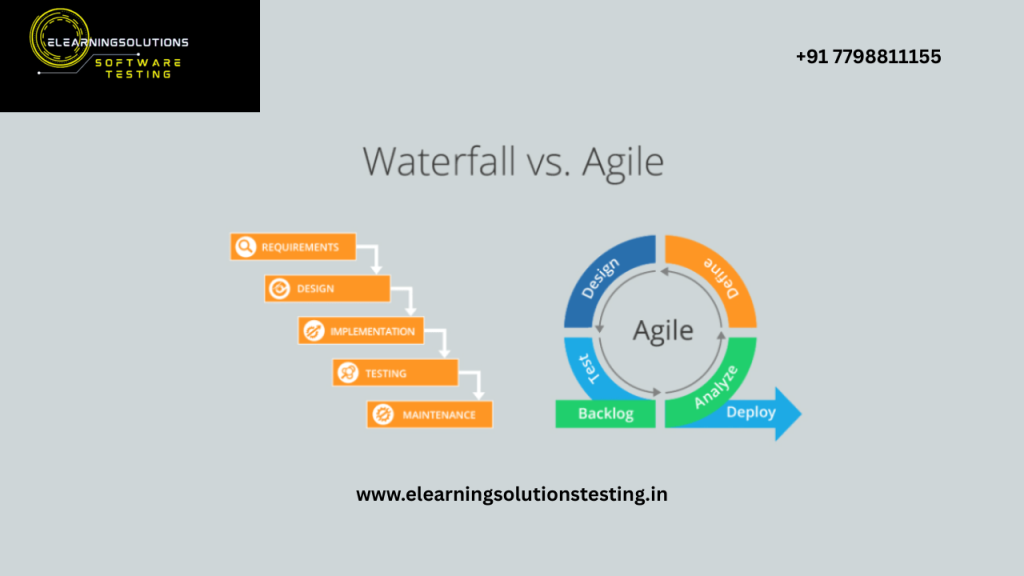
In the Waterfall model, testing starts only after the development phase ends. It follows a strict sequence:
- Requirements →
- Design →
- Implementation →
- Testing →
- Deployment
Pros of Testing in Waterfall:
- Clear documentation and test cases
- Well-defined testing timeline
- Easier to measure progress with milestones
Challenges:
- Late discovery of bugs
- Harder to fix defects (expensive)
- Little room for feedback during development
Example:
If a bug is found during the testing phase, developers may need to revisit months-old code, delaying release.
Testing in Agile: Continuous and Adaptive
In Agile, testing happens in parallel with development — typically within 1- to 3-week sprints. QA is embedded in the Agile team, participating from Day 1.
Pros of Agile Testing:
- Continuous feedback and bug fixing
- Early defect detection
- Better collaboration between QA, devs, and stakeholders
- Supports test automation and DevOps practices
Challenges:
- Fast pace requires skilled testers
- Less documentation
- Scope changes often
Example:
A QA engineer in an Agile team starts writing test cases based on user stories even before development begins, and tests features as soon as they’re ready.
Agile vs Waterfall Testing: Key Differences
| Aspect | Waterfall Testing | Agile Testing |
| Testing Start | After development | With development (Shift Left) |
| Flexibility | Rigid, pre-planned | Adaptive to change |
| Test Documentation | Heavy and predefined | Lightweight, updated iteratively |
| Feedback Cycle | Late (post-dev) | Continuous (each sprint) |
| Team Involvement | Isolated QA role | QA involved in planning & delivery |
| Automation | Minimal | High (supports CI/CD) |
When to Use What?
| Use Case | Recommended Model |
| Projects with fixed scope and requirements | Waterfall |
| Projects requiring fast delivery and change adaptability | Agile |
| Heavily regulated industries (e.g., banking) | Waterfall |
| Customer-driven, feedback-based projects | Agile |
Best Practices for Both Models
- Waterfall: Invest time in requirement clarity and detailed test planning
- Agile: Focus on automation, exploratory testing, and close collaboration
- In both: Use metrics like defect density, test coverage, and test case effectiveness to measure success
Adapt QA to Fit the Model, Not the Other Way Around
Whether you’re using Agile or Waterfall, the key is aligning your testing strategy with your project goals. Knowing how testing fits into your development lifecycle makes your team faster, smarter, and more quality-focused.
Learn Agile Testing, Test Planning, and DevOps Automation
Join our hands-on QA courses designed for beginners, professionals, and teams looking to modernize testing practices.
You may be interested in:
What are the Levels of Testing in Software Engineering
Different types of manual testing
Automation testing in Selenium
API Testing in Software Testing
Frequently Asked Questions
What is the primary difference in testing approaches between Agile and Waterfall methodologies?
In Agile, testing is integrated throughout the development process, with continuous iteration and refinement, whereas in Waterfall, testing occurs in a separate phase after development is complete. This difference significantly affects the speed and adaptability of the testing process. As a result, Agile allows for more flexibility and faster response to changes.
How does the role of a tester differ in Agile versus Waterfall environments?
In Agile, testers are integral members of the development team, participating in planning and development activities, whereas in Waterfall, testers typically work in isolation, focusing solely on testing the final product. This difference in roles affects the level of collaboration and communication between testers and developers. Testers in Agile environments often require a broader range of skills to contribute effectively.
Which methodology is better suited for projects with rapidly changing requirements?
Agile is generally better suited for projects with rapidly changing requirements due to its iterative and adaptive nature, allowing for quick responses to changes and new requirements. In contrast, Waterfall is more suited for projects with well-defined and stable requirements, as changes can be difficult and costly to implement. Agile’s flexibility makes it a more popular choice for projects with uncertain or evolving requirements.
Can Waterfall projects still incorporate iterative testing and feedback loops?
While Waterfall is typically characterized by a linear and sequential approach, it is possible to incorporate iterative testing and feedback loops into a Waterfall project, although it may require some adjustments to the traditional methodology. However, this can be challenging and may not be as effective as in Agile, where iteration is a core principle. Incorporating iterative elements into Waterfall can help improve the overall quality of the final product.
How do the different testing approaches in Agile and Waterfall affect the overall project timeline and budget?
The testing approach in Agile can lead to faster time-to-market and reduced overall project timelines, as testing and development occur concurrently, and issues are identified and addressed earlier. In contrast, Waterfall’s sequential approach can lead to longer timelines and potentially higher costs due to the need to revisit and rework earlier stages if issues are discovered late in the process. Agile’s approach can also help reduce the risk of cost overruns by identifying and addressing issues earlier.


