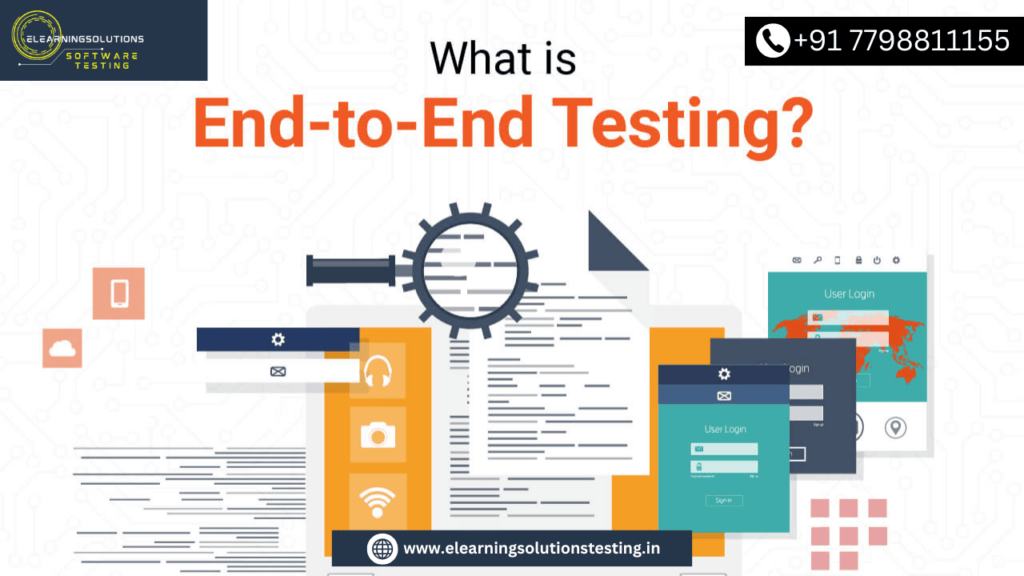

An application’s flow from beginning to end can be tested using the software testing methodology known as end-to-end testing. This testing aims to replicate the actual user situation and verify the data integrity and integration of the system being tested and its constituent parts.
It is carried out from beginning to end in real-world situations, such as when the program communicates with hardware, a network, a database, and other apps.
Determining an application’s dependencies and making ensuring that accurate information is shared amongst system components are the primary goals of this testing. It is often carried out following the conclusion of an application’s system and functional testing.
Let us take the example of Gmail

End to End Verification of a Gmail account will include the following steps:
- Launch a Gmail login page through URL.
- Log into the Gmail account using valid credentials.
- Access Inbox. Open Read and Unread emails.
- Composing a new email, reply or forward an email.
- Open Sent items and check emails.
- Check the emails in the Spam folder
- Log out of the Gmail application by clicking on ‘logout’
End-To-End Testing Tools
Recommended Tools:
#1) Avo Assure

Avo Assure is a 100% scriptless test automation solution that helps you test end-to-end business processes with a few clicks of the buttons.
Being heterogeneous, it enables you to test applications across the web, windows, mobile platforms (Android and IOS), non-UI (web services, batch jobs), ERPs, Mainframe systems, and associated emulators through one solution.
With Avo Assure, you will be able to do the following:
- Achieve end-to-end test automation because the solution is no-code and enables testing across diverse applications.
- Get a bird’s eye view of your entire testing hierarchy, define test plans, and design test cases through the Mindmaps feature.
- With a click of a button, enable accessibility testing for your applications. It supports WCAG standards, Section 508, and ARIA.
- Leverage integration with various SDLC and continuous integration tools like Jira, Sauce Labs, ALM, TFS, Jenkins, QTest, and more.
- Schedule execution during non-business hours.
- Execute test cases in a single VM independently or in parallel with the Smart Scheduling and Execution feature.
- Analyze reports quickly as they are now available as screenshots and videos of the execution process.
- Reuse 1500+ pre-built keywords and 100+ SAP-specific keywords to expedite testing further.
- Avo Assure is certified for integration with SAP S4/HANA and SAP NetWeaver.
#2) testRigor

testRigor gives manual QA testers the ability to create complex end-to-end test automation with plain English language statements. You can easily build tests spanning multiple browsers, including mobile devices, API calls, emails, and SMS – all in one test with no coding.
Key points that put testRigor on the list are as follows:
- No technical knowledge of code, Xpath, or CSS selectors is required to create complex test automation.
- testRigor is the only company that’s solving the test maintenance problem.
- Manual QA is empowered to own part of the test automation process.
With testRigor, you will be able to:
- Build test cases 15x faster with plain English.
- Reduce 99.5% of your test maintenance.
- Test multiple browsers and operating system combinations in addition to Android and iOS device testing.
- Schedule and execute tests with one click of a button.
- Save time by executing test suites in minutes instead of days.
=> Visit testRigor Website
#3) Virtuoso

In-sprint, end-to-end test automation is now a reality rather than simply a pipe dream thanks to Virtuoso, an AI-augmented test automation system. Speed and complete accessibility can be achieved with a codeless, scripting method without sacrificing the flexibility and power of code. With self-healing testing, maintenance is reduced to almost nothing. Say goodbye to flaky.
The most thorough and user-focused end-to-end testing can be provided by utilizing Virtuoso’s core functional UI testing in conjunction with an API client and out-of-the-box visual regression, snapshot, and localization test capabilities..
- Any browser, any device
- Combined Functional UI and API testing
- Visual regression
- Snapshot testing
- Accessibility testing
- Localization testing
- A comprehensive tool for all your end-to-end testing needs
How the End-To-End Test Works
To understand a bit more, let us find out How it works?
Consider the banking sector as an illustration. I think some of us have experimented with stocks.A specific percentage of the proceeds must be delivered to the broker if a Demat account holder buys any shares. Whether a shareholder makes money or loses money when he sells a share, the broker is awarded a certain percentage of the proceeds. The account manages and reflects each of these transactions. Throughout the entire process, risk management is used.
The entire procedure involves several numbers and varying transaction levels, as we can see when we examine the aforementioned case while keeping the End-to-End test in mind. There are numerous systems involved in the process, many of which can be challenging to test.
E2E Testing Methods
#1) Horizontal Test
This method is used very commonly. This occurs horizontally across the context of multiple applications. This method can easily occur in a single ERP (Enterprise Resource Planning) application. Take an example of a web-based application of an online ordering system. The whole process will include accounts, inventory status of the products as well as shipping details.
#2) Vertical Test
This approach verifies and assesses every transaction in an application from beginning to end. From top to bottom, every single layer of the application is evaluated. Consider a web-based application that connects to web servers via HTML codes. In these situations, SQL codes against the database must be generated via the API. All of these intricate computing scenarios will need thorough testing and appropriate validation. This approach is therefore even more challenging.
‘Both White Box testing’ as well as ‘Black Box Testing’ are associated with this testing. Or in other words, we can say, this is the combination of benefits of both white box testing and black-box testing. Depending on the type of software being developed, at different levels, both the testing techniques i.e. white box and black box testing will be used as and when required. Basically, End to End testing performs functional as well as architectural approaches for any software or programs to validate system functions.
Testers like End to End verification because writing test cases from the user’s perspective and in a real-world scenario can avoid the two common mistakes .i.e. missing bugs and writing test cases that do not verify real-world scenarios, this provides testers with an immense sense of accomplishment.
Given below are a few guidelines that should be kept in mind while designing the test cases to perform this type of testing:
- Test cases should be designed from the end user’s perspective.
- Should focus on testing some of the existing features of the system.
- Multiple scenarios should be considered for creating multiple test cases.
- Different sets of test cases should be created to focus on multiple scenarios of the system.
This testing is similar to the execution of test cases. If the test cases are ‘Pass’ or we have received the expected output, it can be said that the system has successfully passed the End to End test. Likewise, if the system does not produce the desired output, then a retest of a test case is required keeping in mind the areas of failure.
Why Do We Perform E2E Testing
A contemporary software system in the current context is made up of its connections to numerous subsystems, as depicted in the diagram above. Because of this, contemporary software systems are extremely complex.
The subsystems we are discussing may be part of the same organization or, more often than not, may be part of multiple organizations. Additionally, the existing system and these subsystems may differ or be substantially similar. Therefore, if any subsystem fails or has a flaw, it might negatively impact the entire software system and cause it to collapse.
These major risks can be avoided and can be controlled by this type of testing:
- Keep a check and perform system flow verification.
- Increase the test coverage areas of all the subsystems involved with the software system.
- Detects issues, if any with the subsystems and thus increases the productivity of the whole software system.
Below mentioned are the few activities that are included in the end to end process:
- A thorough study of the requirements to perform this testing.
- Proper set up of test environments.
- A thorough study of Hardware and Software requirements.
- Descriptions of all subsystems as well as the main software system involved.
- Enlist the roles and responsibilities of all the systems and subsystems involved.
- Testing methods used under this testing as well as standards that are followed, its described.
- Designing of test cases as well as tracing requirement matrix.
- Record or save the input and output data for each system.
E2E Testing Design Framework
We will look into all 3 categories one by one
#1) User Functions: The following actions should be performed as part of building User Functions:
- Listing features of the software systems and their interconnected sub-systems.
- For any function, keep track of the actions performed as well as Input and Output data.
- Find relations, if any, between the different User functions.
- Find out the nature of different user functions i.e. if they are independent or reusable.
#2) Conditions: The following activities should be performed as part of building conditions based on user functions:
- For each and every user function, a set of conditions should be prepared.
- Timing, data conditions, and other factors that affect user functions can be considered as parameters.
#3) Test Cases: The following factors should be considered for building test cases:
- For every scenario, one or more test cases should be created to test each and every functionality of the user functions.
- Every single condition should be enlisted as a separate test case.
Metrics Involved
Let’s look at the important activities and metrics involved in this testing.
- Status of Test case preparation: This can be tracked in the form of a graph to represent the progress of the planned test cases that are under preparation.
- Weekly tracking of Test progress: This includes a week-wise representation of the test case execution progress. This can be reflected through percentage representation for pass, fail, execute, not executed, invalid, etc.
- Status and detailed report for Defects: The Status report should be prepared on a daily basis to show the test case execution status as well as defects found and logged as per their severity. Weekly, the percentage of open and closed defects should be calculated. Also, based on defect severity and priority, the defect status should be tracked on a weekly basis.
- Test environment: This keeps track of the test environment time duration allotted as well as the test environment time used while performing this testing.
Now, we have seen almost all aspects of this testing. Now let us differentiate “System Testing” and “End to End testing”. But before that, let me give you a basic idea of “System testing” so that we can easily differentiate between the two forms of software testing.
System testing is the form of testing which includes a series of different tests whose purpose is to perform the complete testing of the integrated system. System testing is basically a form of black-box testing where the focus is on the external working of the software systems from the user’s point of view keeping real-world conditions as consideration.
System testing will involve the following:
- Testing a fully integrated application including the main system.
- Determine the components that interact with one another and within the system.
- Verify the desired output according to the input provided.
- Analyze the user’s experience while using various aspects of the application.
Above we have seen the basic description of System testing to understand it. Now, we will look at the differences between “System Testing” and “End to End testing”.
| S.No. | End to End Testing | System Testing |
|---|---|---|
| 1 | Validates both the main Software system as well as all the interconnected Sub-Systems. | As per the specifications provided in Requirement document, it just validates the software system. |
| 2 | The main emphasis is on verifying the end to end testing process flow. | The main emphasis is on verifying and checking features and functionalities of the software system. |
| 3 | While performing testing, all the interfaces including the backend processes of the software system is taken under consideration. | While performing testing, only the functional and the non- functional areas and their features are considered for testing. |
| 4 | End to End testing is executed /performed after the completion of System testing of any software system. | System testing is basically performed after the completion of integration testing of software system. |
| 5 | Manual testing is mostly preferred for performing end to End testing as these form of testing involves testing of external interfaces also which can be very difficult to automate at times. And will make the whole process very complex. | Both manual and automation testing can be performed as a part of System testing. |
Conclusion
I hope this post clarified the differences between system and end-to-end testing as well as the many facets of end-to-end testing, including their procedures and metrics.
End-to-end verification is crucial for any commercial software release because it evaluates the complete program in a setting that closely mimics real-world user interactions, such as database interaction and network connectivity.
Because automating such test cases is too expensive for every firm, end-to-end testing is typically done by hand. This might be regarded as helpful for testing external integration in addition to system validation.
Enjoy reading more blogs:
Integration testing advantages and disadvantages (2024 Update)
What is dichotomies in software testing?
Automation testing course in Pune
API Testing in Software Testing
Frequently Asked Questions
What is End to End Testing?
End to End Testing is a software testing method that involves testing an application from start to finish, simulating real user scenarios to ensure that the application works as expected. It covers the entire application, from user authentication to the final output, and verifies that all components work together seamlessly. This type of testing helps identify issues that may not be caught during unit or integration testing.
Why is End to End Testing important?
End to End Testing is important because it helps ensure that an application meets the required specifications and works as expected in real-world scenarios. It also helps identify and fix issues early on, reducing the risk of downstream problems and improving overall quality. By testing the application from end to end, teams can catch issues that may not be apparent during unit or integration testing.
How does End to End Testing differ from Unit Testing?
End to End Testing differs from Unit Testing in that it tests the entire application, including all components and interactions, whereas Unit Testing focuses on individual components or units of code. End to End Testing simulates real user interactions, while Unit Testing typically uses mock data and focuses on specific functions or methods. This difference in scope and approach makes End to End Testing a more comprehensive and realistic testing method.
What tools are commonly used for End to End Testing?
Common tools used for End to End Testing include Selenium, Cypress, and Appium, which provide a framework for automating user interactions and verifying application behavior. These tools support a range of programming languages and can be used to test web, mobile, and desktop applications. They also provide features such as test recording, scripting, and reporting, making it easier to create and maintain End to End tests.
How can I get started with End to End Testing?
To get started with End to End Testing, begin by identifying the key user journeys and scenarios that you want to test, and then select a suitable testing tool based on your application type and technology stack. Next, create a test plan and start writing test scripts, using the tool’s features to automate user interactions and verify application behavior. It’s also essential to integrate End to End Testing into your Continuous Integration and Continuous Deployment (CI/CD) pipeline to ensure that tests are run regularly and consistently.